Plants

Musclewood

Passing through the Texas woods your eye may well be captured by the smooth, strong looking trunk of a hop hornbeam tree. Due to its appearance it has two other common names, musclewood and ironwood. It prefers full shade and stays small so …
Read More »
Yucca

The flower stalk is sweet-tasting before it produces flower pods/flowers. Roast or pickle it before the pods appear. As the flower pods mature the stalk becomes tasteless and tough. After the flowers have past the ripe fruit of the thick-leaf …
Read More »

Yarrow

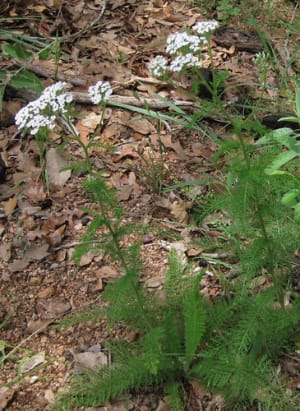
Look for yard along the edges of woods just inside the shady areas as well as in fields, especial across Central Texas. The finely divided leaves, from which it gets part of its scientific name “millefolium” give it a wild carrot-like appearance …
Read More »

Wood Sorrel

Patches of wood sorrel are very prevalent on forest floors, often near wild violets, cleavers, wild onions, etc… The three-lobed leaf looks similar to clover/shamrocks but sorrels have a cleft at the top, giving them a heart-shape whereas …
Read More »

Wolfberry

As you cross the dry, sandy, alkaline soils of south and west Texas and southern coastal areas you make see a gray-colored bush covered in thick, elongated oval leaves. Depending on the time of year, the bush may be covered in long, tubular, …
Read More »

Wisteria

The fragrant flowers of wisteria make a wonderful addition to salads or just nibbled as a raw snack. Long ago they were used to flavor wines, but I haven’t had a chance to try that. Note that all other parts of the plant (leaves, stem, seeds …
Read More »

Wireweed

Stroll past any disturbed area, especially one that’s a bit damp, and you are almost guaranteed to come across lots of this wiry, weedy, sparsely-leafed, yellow flowered plant called wireweed. It seems to love the edges of parking lots, underpasses, …
Read More »

Wine Cup

Wine cup tubers can be found in dry, sandy fields, especially in the Texas Hill Country. The leaves are best cooked where their okra-like tendencies can be used to thicken stews. The tubers taste like sweet potatoes and can be eaten raw or …
Read More »

Willow

The long, wispy branches of willow trees give them an appearance unlike any other tree. They require a lot of water so look for them along wet areas. Their high demand for water can cause problems when used in landscaping as their roots will …
Read More »

Wild Violet

Wild violets are a wonderful winter/spring nibble and if you’re lucky, summer and fall, too! They prefer cool, damp areas of woods during the summer but during the winter they can be found in sunnier locations including yards. The heart-shaped …
Read More »