I. Introduction
II. Tea: Black, Oolong, and Green
III. Herbal Flavors
IV. Health Benefits
V. Techniques of Preparation
VI. Harvesting, Drying, and Storage
VII. Growing Herbs in Houston
I. Introduction
So, what's all this about teas and why are they so dang healthy? As usual, it's all about the chemistry. You basic “Lipton's” tea is loaded with a number of beneficial chemicals with the main class being known as “flavoniods”. Most flavonoids work as antioxidants which is just a fancy way of saying they get rid of the bad, highly-reactive molecules (aka free radicals) in your body. These free radicals would normally bounce around ripping apart other necessary molecules, which is a very bad thing. Getting rid of the free radicals greatly reduces molecular damage to your cells, which is a very good thing.
If all you want to do is protect your molecules from destruction then regular tea is fine. However, why stop there? How about adding chemicals that can perk you up or make you relax, chemicals that can stimulate your immune system or settle down your stomach, chemicals that can reduces cramps or clear your sinuses of goo, maybe even extend your life? Yeah, they can do that and more. Let's learn more, shall we?
II. Tea: Black, Oolong, and Green
The most common teas (Black, Oolong, and Green) all come from the Camellia sinensis plant, originally from Asia. The difference between the three depends on how the leaves are treated after picking, mainly how much enzymatic breakdown they are allowed to undergo. This natural chemical process occurs as the leaves are dried and and once the proper level of breakdown has occur the leaves are heated to stop further breakdown.
Green tea is the least “broken” of the teas and so maintains the highest concentrations of beneficial chemicals but has the weakest flavor by most Western standards. Oolong tea is partially broken giving it a richer flavor and a slight reduction in the chemicals we seek. Black tea is allowed to break down the farthest. This results in the richest taste but a reduction of many helpful chemicals except for the antioxidants. But even Black tea been shown to reduce the clogging of arteries, inhibit cancer growth, and fight some viruses!
III. Herbal Flavors
Besides the assorted health and wellness chemicals available in herbal teas (sect. IV), they offer a whole world of tastes. Mixing and matching these flavors is one of the great joys of herbal tea.
SWEET
- Anise
- Licorice
- Stevia leaves
- Vanilla beans
- Yaupon holly leaves
- Blackberry/Dewberry leaves
- Raspberry leaves
- Apple fruit
- Peach fruit Hawthorn
- Strawberry leaves
FLORAL
- Chamomile flowers & leaves
- Elderberry flowers
- Jasmine flowers
- Lavender flowers
- Basswood/Linden flowers
- Clover (white and red)
- Rose flowers
- Chrysanthemum flowers
MINT
- Spearmint
- Peppermint
- Wintergreen
- Catnip
- Violet
- Basil
- Yerba Santa
SPICY
- Allspice
- Cardamon
- Cinnamon
- Coriander
- Fenugreek
- Ginger
CITRUS*
- Beebalm/Lemon balm
- Lemongrass
- Lemon peel
- Orange peel
- Lime peel
- Sorrel
*Warning: the peel of store-bought citrus fruit may have been treated with fungicides or other potentially toxic compounds. Wash them thoroughly before use or purchase organically grown fruits.
TART
- Rose hips
- Turk's cap flowers
- Hibiscus flowers
- Dock leaves
LICORICE
- Anise
- Fennel
- Licorice
- Star Anise
- Goldenrod leaves & flowers
EARTHY/ROOTY
- Dandelion root
- Burdock root
- Ginseng roots (flavor becomes bitter if left in water too long)
- Chicory root
RESIN
- Rosemary
- Pine needles
- Thyme
- Sage
- Cloves
BITTER
- Chicory root
- Ginseng roots (flavor becomes bitter if left in water too long)
- Yarrow flowers & leaves
- Willow twigs
ARBORACEOUS
- Sarsaparilla roots
- Birch leaves
- Ginseng roots (flavor becomes bitter if left in water too long)
- Sassafras roots
- Burdock root
- Echinacea flowers
- Ephedra bark & twigs
IV. Health Benefits
Now it's time for the best part of herbal teas, the wonderful effects they can have on your body. Do you want to sleep or wake up? Are you suffering from a cold? Do you need your heart, or blood to function better? Do need to calm your stomach or your nerves? Yeah, there's a herb for that.
HERBS FOR ENERGY
- Ginseng
- Yaupon holly (caffeine)
- Licorice
- Tumeric
- Chrysanthemum
- Ephedra
HERBS FOR HEADACHES
- Mint
- Rose hips
- Rosemary
- Thyme
- Lavender
- Chrysanthemum
HERBS FOR IMPROVED HEALTH
- Burdock root – blood purifier, antioxidants
- Cinnamon – improves circulation, may increase longevity
- Dandelion root – stimulates liver, flushes system
- Lemongrass – cleanses blood, liver and kidneys; reduces blood pressure
- Licorice – reduces congestion, improves focus
- Stinging nettle – cleanses blood, stimulates liver & kidneys
- Blackberry/Dewberry – high in vitamins, minerals, and antioxidants; blood cleanser
- Rose hips – vitamin C, antioxidants
- Rosemary – improves liver action and blood circulation, improves memory
- Persimmon – vitamin C
- Sassafras – blood cleanser
- Hibiscus flower – antioxidants, control blood pressure, lowers cholesterol
- Red clover – antioxidants, vitamins, minerals, reduces bad cholesterol, thins blood
- Ginger – reduces morning sickness, reduces arthritis pain and other chronic pain
- Jasmine – antioxidants, lowers bad cholesterol, may fight cancer, boosts immune system
- Ginko Biloba – improves memory
- Chrysanthemum – lowers blood pressure, high in minerals
- Sage – blood purifier, improves liver, kidney, and brain functions,
- Thyme – reduces anemia
- Fennel – reduces pain
- Ginseng – improves immune system, lowers bad cholesterol, improves blood flow
- Hawthorn – strengthens heart tissue & blood vessels, lowers bad cholesterol
- Mint – strengthens immune system
HERBS FOR CALM
- Chamomile Oatstraw
- Basil Valerian root
- Lemon balm St. John's Wort
- Lemongrass Ginseng
- Mint Sage
- Jasmine Licorice
HERBS FOR STOMACH ILLS
- Burdock – reduces indigestion and constipation, increases bile production
- Cardamom – increases digestion, reduces gas
- Chamomile – reduces indigestion
- Cinnamon – reduces indigestion
- Cloves – aids digestion, reduces nausea
- Fennel – improves appetite, stimulates digestion, reduces gas
- Ginger – reduces nausea
- Lemongrass – improves digestion
- Mint – improves digestion, reduces nausea
- Licorice – improves digestion
- Blackberry/Dewberry – helps control diarrhea
- Sage – improves digestion
- Ginseng – increases appetite, helps digestion, cures diarrhea
- Yarrow – increases appetite, improves digestion
- Red clover – reduces gas
- Stevia – reduces heartburn
- Anise – reduces gas and indigestion
- Thyme – reduces gas
- Basil – reduces diarrhea
- Fennel – reduces gas, aids digestion
HERBS FOR COLDS/FLU
- Burdock – reduces congestion, opens airways, reduces fever
- Elderberry – improves immune system
- Fennel – soothes sore throats, reduces coughing
- Ginger – soothes throat, opens sinuses, reduces fever
- Lemongrass – reduces fevers and other cold symptoms
- Licorice – soothes sore throats, reduces coughing
- Stinging nettle – reduces coughing, opens sinuses
- Black berry – soothes sore throat
- Sage – reduces, fever, congestion and coughing
- Strawberry leaves – slows diarrhea, reduces indigestion
- Thyme – reduces coughing and sore throats, strengthens immune system
- Yarrow – reduces congestion and other cold symptoms
- Red clover – expectorant
- Ephedra – reduces congestion
- Anise – expectorant, reduces congestion
- Cinnamon – reduces cold symptoms
HERBS FOR WOMEN
- Cinnamon – reduces menstrual cramps
- Ginger – reduces menstrual cramps
- Lemongrass – reduces menstrual issues
- Licorice – reduces menstrual cramps
- Fennel – stimulates milk flow
- Motherwort – reduces PMS
- Blackberry/Dewberry – general menstrual aid
- Skullcap – reduces PMS mood swings
- Stevia – may help prevent osteoporosis
- Fenugreek – increases lactation
- Red clover – reduces symptoms of menopause due to estrogen mimicking molecules, not for use by pregnant women!
HERBS FOR MEN
- Ginseng – improves blood flow to Mr. Happypants
- Ginko Biloba – improves blood flow to Mr. Happypants
- Ginger – improves blood flow to Mr. Happypants
- Hawthorn – improves blood flow to Mr. Happypants
- Blackberry/Dewberry – improves blood flow to Mr. Happypants
V. Techniques of Preparation
So now let's make the tea. There are a few things to keep in mind to optimize the release of power of your herbs. Being a chemist, I'm going to pull out the big words for this section.
INFUSION
This method is used for soft plant matter such as leaves, flowers, seeds, or crushed fruits/berries. Boiling water is poured over these materials which are then steeped for 10 to 30 minutes. The water is not brought back to a boil but rather it is allowed to slowly cool or heated to below boiling. The longer the herbs are soaked in this water the more flavor, nutrients, and medicinal compounds will be released. However, be careful with some bitter herbs as a long soaking of these can render the tea unfit to drink.
DECOCTION
To decoct means to add the woody herbs to boiling water which is then kept over heat and simmered 20-60 minutes. Roots, bark, and twigs need this more vigorous extraction. As before, the longer you soak the herbs the more you'll get out of them. If making a tea with both soft and woody components first boil the roots/bark/twigs then add the leaves/flowers/fruit and remove from heat.
TINCTURE
Extraction of herbal chemicals with alcohol makes a tincture. The basic rule of thumb is 300-400 grams of herbs are used per liter of alcohol. Let this mixture soak for at least two weeks with shaking every day. Some people leave the herbs in the alcohol others filter them out. Filtering them out makes for a cleaner tincture which I find easier to use. Vodka and rum (80-100 proof) are the alcohols of choice, with rum being better at disguising flavors of harsher herbs. To use, take one teaspoon of the tincture up to three times a day, either straight or added to juice or soda.
WARNING: never use wood alcohol, rubbing alcohol, or methanol to make tinctures.
VI. Harvesting, Drying, and Storage
Okay, so know you know something about the health benefits and flavors of herbal teas, now lets learn about proper collecting and storing of your future tea. It's a pretty easy, but there are a few things you should know to make great teas.
HARVESTING
Now days it is easy to buy tea herbs off the internet or even in grocery stores. However, the fresher the better in most cases and the freshest will be the ones you grow yourself. The best time to harvest your herbs' leaves and flowers is mid-morning after any dew has evaporated but before the day's heat has a chance to really set in. Most of the flavor-producing compounds are produced by chemical reactions in the plant during the night. But these yummy compounds are easily evaporated out of the plant by the sun's heat so the later in the day you wait to pick them the less there will be of these tasty and beneficial chemicals. However if you pick the leaves/flowers while they still have a coating of dew there is a very good chance that they will mildew and turn to a mushy, useless mess during storage.
The time of day is less important for heavier parts of the plant such as roots, twigs, and bark. The proper time to collect these are based more on the calendar than on a clock. Late winter/early spring is usually the right time to collect twigs, roots and bark from trees as this is when they are starting to be flooded with life again after the cold, dark winter. This new life is the vitality you want to tap. On the other hand, the roots of flowers, shrubs, and non-tree-type plants are usually better in the fall. The plant has spent all summer turning sunlight into healthy nutrients and stuffing them into the roots for storage over the winter. Come spring these nutrients were to be used to regrow the plant but now you'll be harvesting that regrowth for yourself.
DRYING and STORAGE
A basic rule of thumb is the thicker the plant matter the thicker you can pile it on top of itself during drying. Leaves are best dried while still on the stems/stalks in bundles hung up in warm, dry areas out of direct sunlight. Remember, you don't want the good chemicals to evaporate away so warm with air circulation is better than hot or direct sunlight. If you have the room, store these bundles hanging somewhere dry. A layer of cheese cloth over them will keep the dust off them.
Flowers should be removed from their stems and gently shaken to get rid of any bugs (though these bugs are a source of protein). Place them on a cookie sheets one layer deep and set them in a dry, warm place. Again, avoid hot areas or direct sunlight. Air gently passing over them with prevent mildewing, molds, or fungi from growing which are BAD for tea. Once dry, place the flowers in lidded, wide-mouth jars. Traditionally porcelain or amber-colored glass jars are preferred to reduce degradation of the herbs by light.
Heavy materials such as roots, bark and twigs should be cut into strips approximately 4″ long and no wider than your little finger, then loosely pile on a cookie sheet. As before, place them in a dry, warm area with moving air to dry them without losing any goodness. Twigs and uncut roots can be bundled and hung like your did earlier with the leaves. Bark and cut roots should be stored in the same manner as flowers.
VII. Growing Herbs in Houston
The most efficient way to grow herbs is in an “herb spiral”. This is simply a six foot wide by three foot high circular ramp of soil. Your herbs are planted along this ramp with their placement determined by their required growing conditions. Plants which need full sun are placed on the south-facing side of the spiral, full shade plants go on the north side. Partial sun/shade plants can go on the east or west sides. The top portion of the spiral dries quickly while the lower levels remain moist so plants that require well-drain soil are planted higher up and moisture-loving plants go in the lower levels. Table 1. lists common herbs and their growing conditions to assist you in planning your herb spiral. Figure 1. shows the basic layout of an herb spiral.
Table 1. Common herbs
| Plant | Light | Water | Height | Width |
|---|---|---|---|---|
| Anise | full sun | well drained | 18”-24” | 12” |
| Basil | full sun | moist | 18”-24” | 12” |
| Beebalm | partial sun | moist | 24”-48” | 12” |
| Catnip | partial sun | well drained | 12”-36” | 12” |
| Chamomile | any | dry | 9” | varies |
| Chrysanthemum** | full sun | dry | 48” | 24'-48” |
| Coriander | sunny* | medium | 12”-36” | 8” |
| Echinacea | sunny | well drained | 3'-4' | |
| Fennel | full sun | well drained | 48” | 24” |
| Fenugreek | full sun | well drained | 24” | |
| Ginger | partial sun | moist | 24” | 12” |
| Hibiscus | full sun | moist | 7' | 5' |
| Lavender | fun sun | well drained | 36” | 24” |
| Licorice | full sun | well drained | 36” | 24” |
| Peppermint | partial shade | moist | 12”-24” | 12”-24” |
| Roses | partial sun | drained | varies | |
| Rosemary | full sun | well drained | 72” | 72” |
| Sage | full sun | well drained | 24”-36” | 24”-36” |
| Spearmint | partial shade | moist | 12”-24” | 12”-24” |
| Stevia | full sun | well drained | 24” | 8” |
| Strawberry | full sun | well drained | 12” | bed |
| Violet | partial sun | moist | 6” | bed |
| Wintergreen | partial shade | moist | 12”-24” | 12”-24” |
| Yarrow | full sun | well drained | 24”-36” | 10” |
Figure 1. Herb spiral
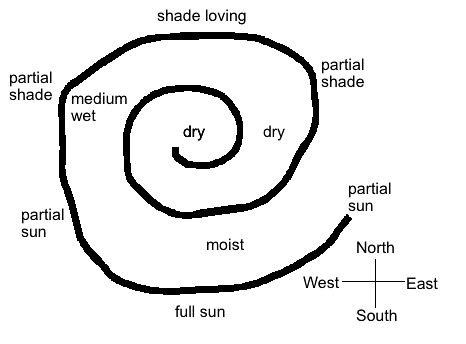
Remember, the spiral should be at or over three feet tall at the center. It is watered from the top, allowing the water to flow down around the spiral.